

Introduction: The “Tuesday at 10 AM” Myth
For the first three years of my career as an email marketing consultant, I lived by a sacred, unquestionable rule: You always send your newsletter on Tuesday at 10:00 AM.
Why? Because every major marketing blog on the internet told me to. They had published massive studies analyzing billions of emails, and the data supposedly proved that Tuesday mid-morning was the absolute peak time for human engagement.
So, I sent my client’s massive B2B software update at exactly 10:00 AM EST on a Tuesday.
The open rate was 11%.
I panicked. I checked the spam filters. I checked the subject line. Everything was fine.
Then I looked at the actual subscriber list. My client’s audience consisted heavily of night-shift nurses, international developers in Asia, and freelance designers who slept until noon.
Sending an email to a nurse in London at 10:00 AM EST meant it arrived at 3:00 PM local time—right in the middle of their shift. Sending it to a freelance designer in California meant it arrived at 7:00 AM, buried under 50 other promotional emails they would mass-delete when they woke up.
The “Tuesday at 10 AM” rule isn’t just slightly inaccurate; it is actively harmful to your deliverability. It treats a global, diverse list of human beings as a single, synchronized monolith.
In 2026, guessing the best time to send an email is obsolete. In this guide, I’m going to break down exactly how AI Send Time Optimization (STO) actually works behind the scenes, why traditional A/B testing fails to solve this problem, and how to implement a predictive sending model that respects the individual habits of your subscribers.
Why This Problem Happens (The “Batch and Blast” Failure)
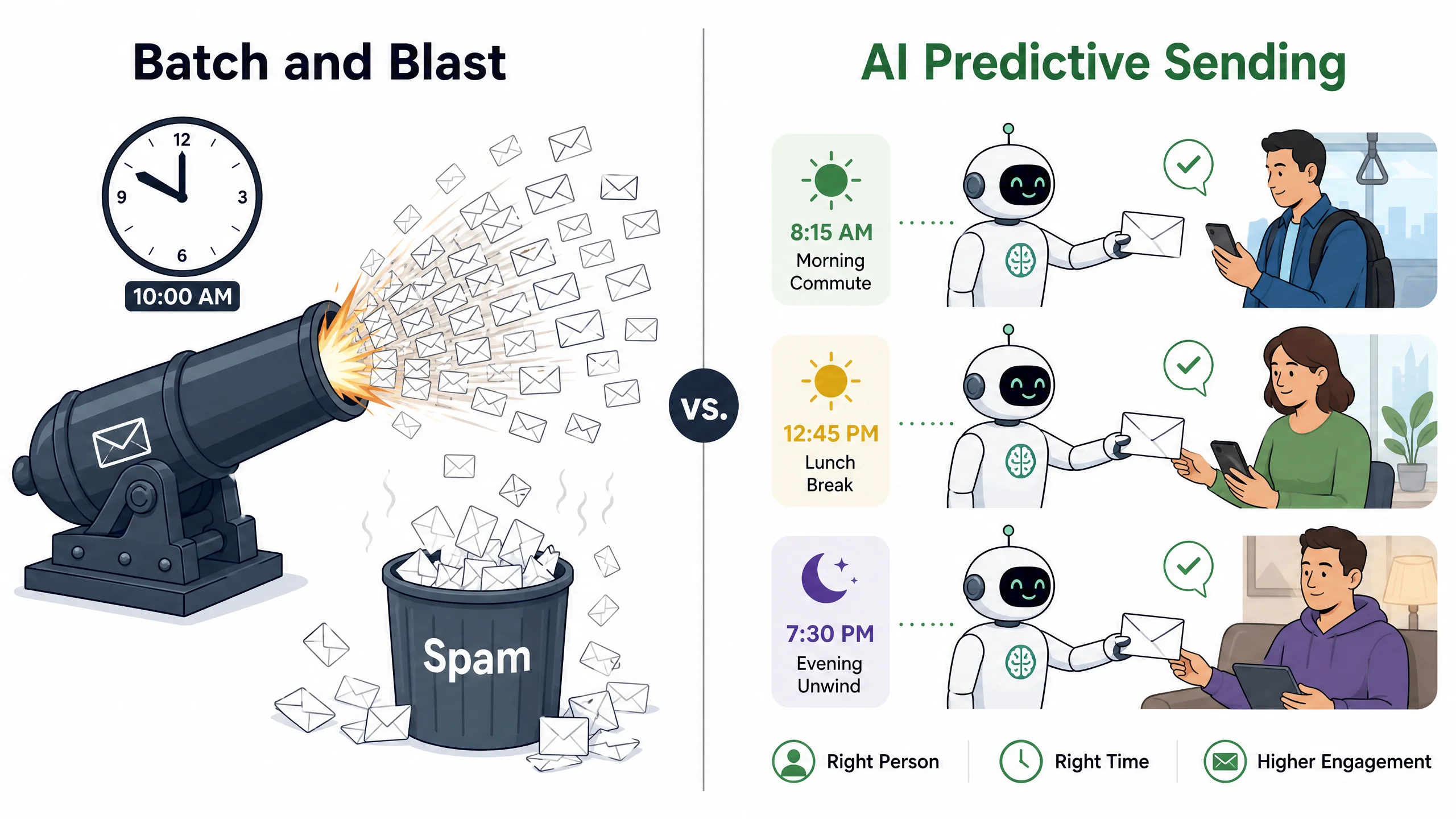
To understand why AI is necessary, we have to look at the mechanics of the traditional “Batch and Blast” method.
When you schedule an email for 10:00 AM, your Email Service Provider (ESP) attempts to push all 50,000 emails out the door at that exact second.
This creates two massive problems:
- The Inbox Avalanche: You are not the only marketer who read that Tuesday at 10 AM is the best time to send. Thousands of other companies are blasting their lists at the exact same moment. Your email arrives in the subscriber’s inbox sandwiched between 15 other promotional emails. It becomes a lottery of who has the catchiest subject line.
- The Deliverability Spike: When an Internet Service Provider (like Gmail) suddenly sees 50,000 emails hitting their servers from your IP address in a 3-minute window, it triggers their anti-spam defenses. They might throttle your delivery, routing a large portion of your emails to the Promotions tab or Spam folder just to be safe.
Hidden Causes Most Articles Ignore (The A/B Testing Trap)
When marketers realize that 10 AM isn’t working, their first instinct is to run an A/B test.
Send half the list at 9 AM, and the other half at 4 PM. See which wins.
This is a logical approach, but it contains a hidden flaw: The Fallacy of Averages.
Let’s say the 4 PM send wins with a 22% open rate, compared to 18% for the 9 AM send. You declare 4 PM the winner and start sending all future emails at 4 PM.
But what about the 18% of people who preferred the 9 AM slot? You have just alienated them to cater to the majority.
A/B testing time slots forces you to find the “least bad” time for the average subscriber. It is still a compromise. You are still treating your list as a monolith.
How AI Send Time Optimization Actually Works (The Mechanics)
AI Send Time Optimization (STO) abandons the concept of an “average” subscriber entirely. Instead of asking, “When is the best time to send to my list?” it asks, “When is the best time to send to Sarah?”
Here is the exact mechanism of how a predictive AI model processes your email send.
1. The Historical Data Ingestion
When you turn on STO, the AI engine in your ESP (like ActiveCampaign or GetResponse) doesn’t look at global marketing trends. It looks exclusively at your historical data.
It analyzes the last 90 to 180 days of engagement for every single subscriber on your list. It records the exact timestamp of every open, every click, and every purchase.
2. The Habit Profile Creation
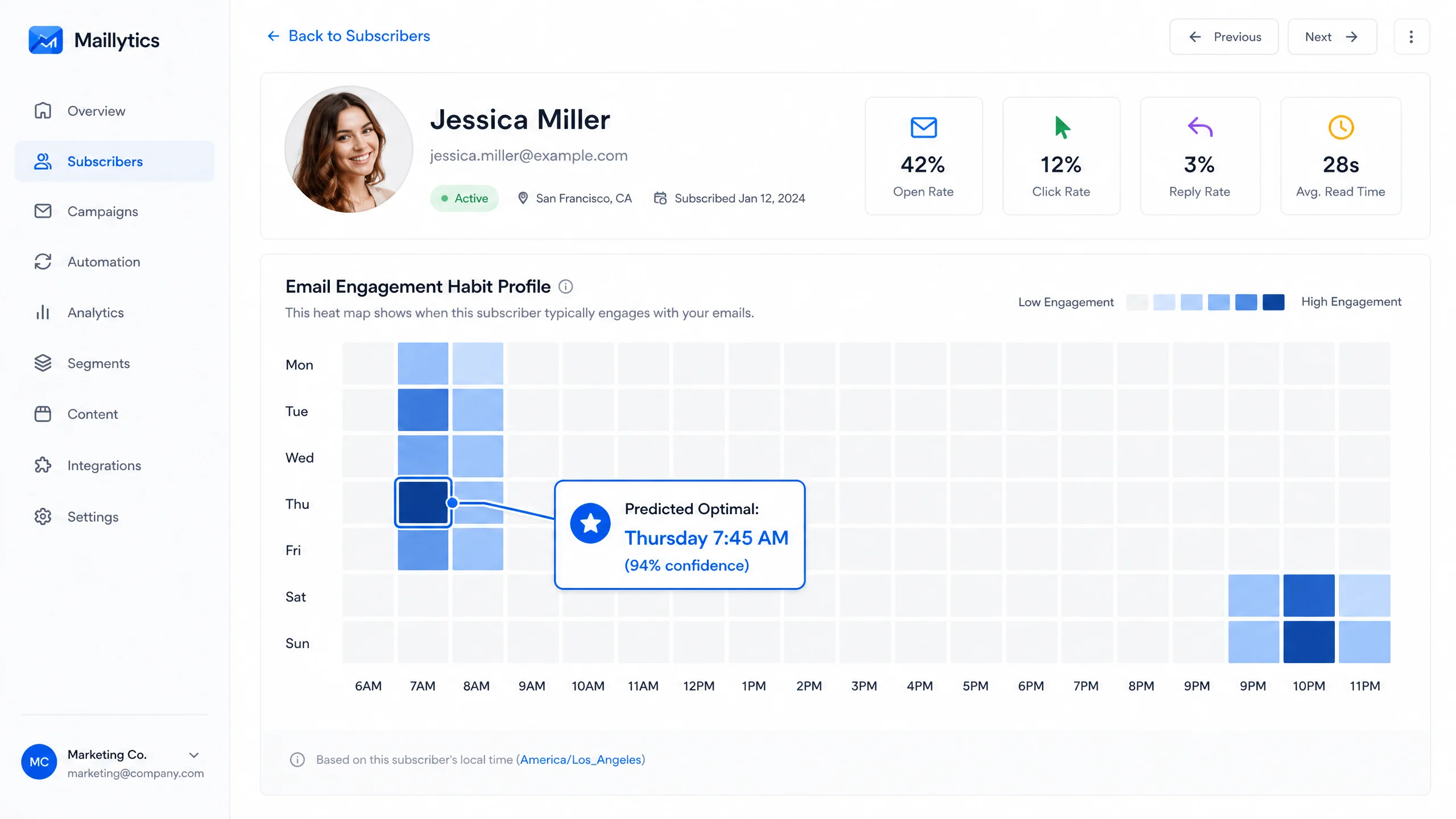
The AI builds a unique “Habit Profile” for each user.
It might determine that Subscriber A (a busy executive) only opens emails on their phone between 6:30 AM and 7:00 AM during their commute.
It might determine that Subscriber B (a stay-at-home parent) consistently opens emails around 9:00 PM after the kids are asleep.
3. The Predictive Scoring Algorithm
When you hit “Send with STO,” the email doesn’t go out immediately.
Instead, the AI calculates a probability score for the next 24 hours for every subscriber. It assigns a weight to each hour based on their Habit Profile. The hour with the highest probability score becomes their assigned delivery window.
4. The Micro-Batch Delivery
Instead of one massive blast, your ESP breaks your send into 24 micro-batches.
Subscriber A gets their email at 6:30 AM. Subscriber B gets theirs at 9:00 PM.
Your email arrives at the exact top of their inbox at the precise moment they are most likely to be holding their phone and looking at their email app.
Real Workflow Example: The B2B SaaS Launch
I implemented AI STO for a B2B SaaS company launching a new enterprise feature. Historically, their product update emails hovered around a 19% open rate when sent at their standard Wednesday 11 AM slot.
We used ActiveCampaign’s Predictive Sending feature for the launch.
We finalized the email copy on Monday and scheduled the STO send to begin on Tuesday morning, allowing it a full 24-hour window to deliver.
The results were fascinating to watch in real-time.
- A small batch went out at 5 AM to the early risers in Europe.
- A steady stream went out during the US morning commute.
- Surprisingly, nearly 15% of the list received the email between 8 PM and 11 PM local time—a time slot the marketing team would never have manually chosen for a B2B email.
The final open rate for the launch email was 34.2%.
We nearly doubled the engagement without changing a single word of copy or the subject line. We just stopped fighting the natural habits of our subscribers.
If you are tired of playing the guessing game with your broadcast times, you need an ESP that has native machine learning built in. I highly recommend ActiveCampaign for advanced B2B lists, as their predictive sending algorithm is currently one of the most accurate on the market.
Mistakes To Avoid
- Using STO on Brand New Lists: AI needs data to make predictions. If you have a brand new list, or a segment of subscribers who have never opened an email from you, the AI has no historical data to pull from. In these cases, it will usually default to your account’s average send time. You need at least 30-60 days of consistent sending before STO becomes truly effective.
- Using STO for Urgent Flash Sales: If you are running a “4-Hour Only Flash Sale,” do not use STO. Because STO spaces the delivery out over a 24-hour window, someone might receive the email 12 hours after the sale has already ended. STO is for newsletters, content delivery, and evergreen promotions.
- Obsessing Over “Timezones”: Many marketers manually segment their lists by timezone and schedule separate sends. STO makes this completely unnecessary. The AI automatically accounts for the user’s local time because it is basing the delivery on their actual engagement timestamps.
Advanced Optimization: Combining STO with Send Time Throttling
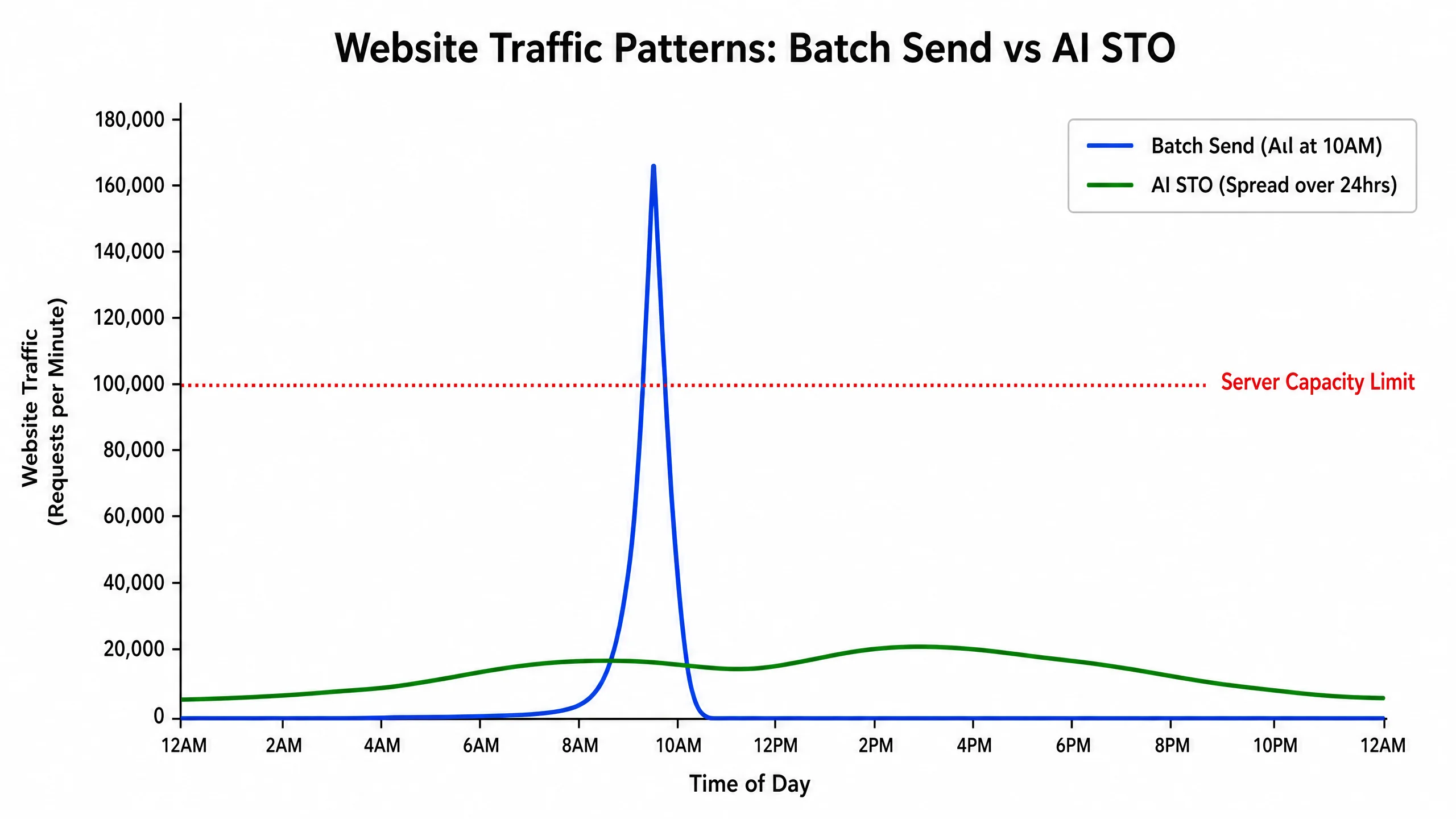
If you have a massive list (e.g., 500,000+ subscribers) and you are directing them to a specific landing page, STO provides an incredible hidden benefit: Server Load Management.
When you use the “Batch and Blast” method, 50,000 people might click your link in the first ten minutes. If your website hosting isn’t robust, your site will crash, killing your conversion rate.
Because STO naturally spaces your email delivery out over a 24-hour period, it acts as a built-in traffic throttle. Your website receives a steady, manageable stream of highly engaged visitors throughout the day, rather than a massive, server-crushing spike.
FAQ
Q: Does STO actually improve click-through rates, or just open rates?
A: Both. Because the email arrives when the user is actively engaged with their inbox (rather than buried under 50 other emails), they are in a better mindset to read and click. My clients typically see a 15-25% lift in CTR when switching to STO.
Q: Which email platforms offer the best AI Send Time Optimization?
A: For advanced users and B2B, ActiveCampaign and HubSpot have excellent predictive models. For ecommerce, Klaviyo and Omnisend have highly accurate STO built specifically for shopping habits. For creators and bloggers, GetResponse offers a very user-friendly “Perfect Timing” feature.
Q: What happens if a subscriber’s habits change?
A: The AI model is dynamic. It constantly ingests new data. If a subscriber gets a new job and starts opening emails at 7 AM instead of 9 PM, the AI will recognize the pattern shift within a few weeks and adjust their delivery window automatically.
Final Takeaways
The era of the “perfect time to send an email” is over. Your subscribers are individuals with unique lives, schedules, and habits.
- Stop treating your email list as a monolith. The “Tuesday at 10 AM” rule is a myth that hurts your deliverability.
- A/B testing time slots is flawed because it caters to the “average” subscriber and alienates the rest.
- AI Send Time Optimization works by building individual habit profiles based on historical open and click data.
- STO spaces your delivery out over 24 hours, which protects your domain reputation and prevents website server crashes.
- Only use STO for evergreen content; avoid it for highly time-sensitive flash sales.
Let the AI do the math. You focus on writing great content.